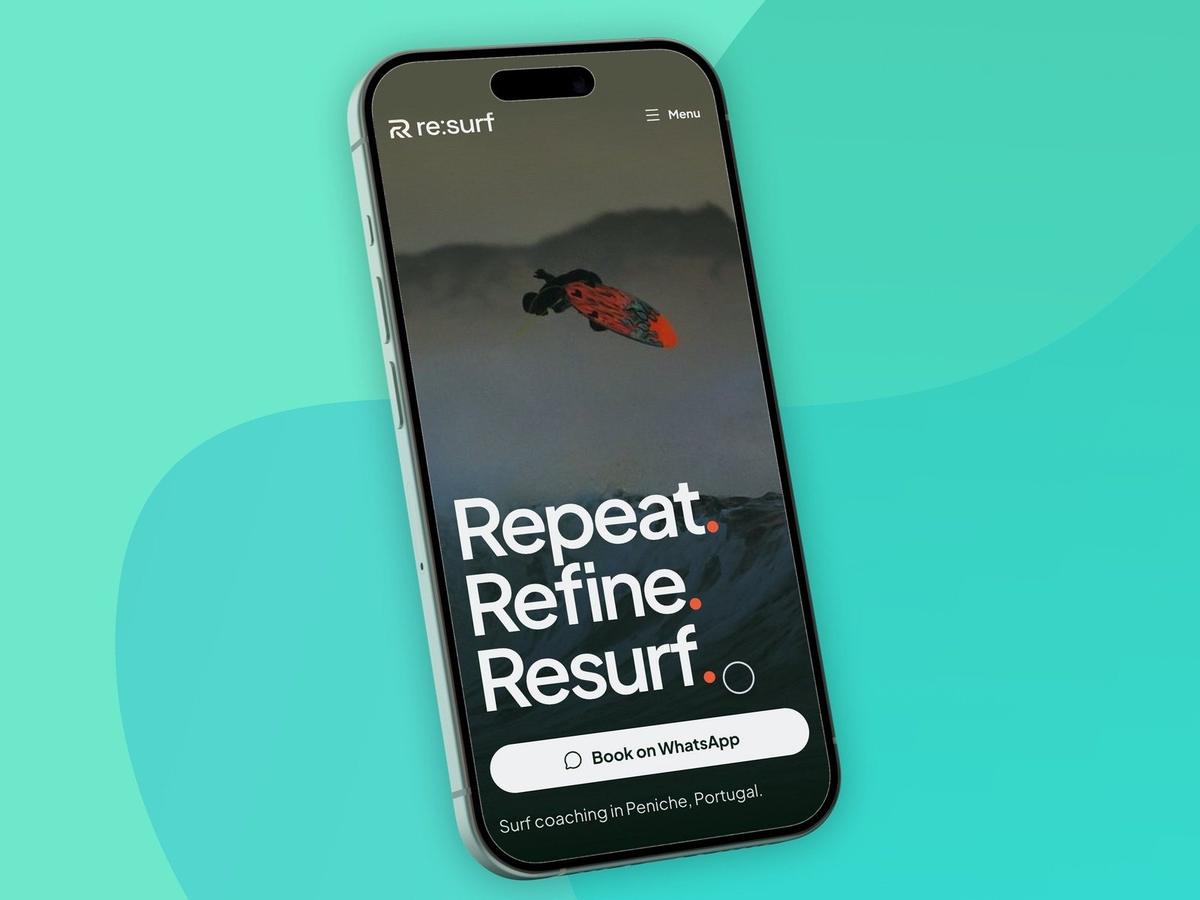
re:surf
A focused platform for a Peniche surf coach and his students: he logs each session, and every student sees the one thing to work on next.690 videos and 21 students so far.
690
videos streamed through Mux
21
students
70
published sessions
5.0
on Google from 12 reviews
- Role
- Designer and developer, for a surf coach
- Stack
- Next.js, TypeScript, Mux for video
- Live
- resurf.pt
The problem
The instructor coaches intermediate and advanced surfers in the water, with video analysis on the beach.
The feedback lived in WhatsApp threads and phone galleries: hard to find later, easy to lose, and impossible to turn into a visible path of progress.
He needed something light enough to use between sessions, with a budget to match.
The calls
Start on WhatsApp
The public site has one action: Book on WhatsApp.
It is only the first touchpoint: students then buy a package from him and book their sessions inside the platform.
Explain the coaching
The page walks through four steps: message me, surf together, your logbook, one focus.
It shows a sample logbook entry, so a new student sees what they will get.
End with one focus
After each session Lucas writes what went well, what to improve and one focus for next time.
The student sees that focus first when they open the app.
Entries can be written in English or Portuguese, since his students are both.
A session takes a few minutes to log, and 70 sessions are published so far.
Video in the log
Each session carries its videos, about four per surfer per session, 690 in total.
Mux handles encoding and streaming, so there is no video infrastructure to maintain and the cost follows usage.
Results
- 21 students and 70 published sessions
- 690 videos uploaded and streamed through Mux
- 5.0 on Google from 12 reviews
- Two sides of one product: a coach dashboard (students, sessions, packages) and a private logbook for each student
What I learned
The best product decision was what to leave out.
Booking starts as a conversation on WhatsApp, and the platform only does what the coach needs between sessions: the logbook, the classes and the packages.
The logbook solved the problem he actually had.